

 (+86)18613012387
 info@royallee.cn
 EN
EN CN
CN TH
TH IDN
IDN  AR
ARGastroscopy and colonoscopy are key to the early detection of gastrointestinal tumors. The experience of the patient below reminds us that early cancer screening is not just a healthy choice; it's a crucial battle to detect cancer early.
"I just came for a check-up, I never expected them to find a 'bomb'!" Recently, Mr. Lin underwent a painless gastroscopy and colonoscopy at the Guangzhou Royal Lee Hospital Endoscopy Center. In a single procedure, doctors identified three early-stage tumors hidden in his transverse colon and rectum. Prior to this, aside from occasional constipation, Mr. Lin had no typical symptoms like abdominal pain or blood in his stool. This examination was an unexpected but critical discovery.
Leveraging their extensive experience, the team led by Director Zuping Li of the Endoscopy Center immediately performed an Endoscopic Mucosal Resection (EMR), completely removing the lesions. Postoperative pathological findings revealed that two of the lesions were precancerous, and one had already undergone focal malignant transformation. Fortunately, it was detected extremely early. The lesions were completely resected with clear margins and no vascular invasion, meaning the early-stage cancer had been "uprooted" at its source. Mr. Lin recovered smoothly after the procedure and was soon discharged from the hospital.
Why Does Bowel Cancer Often Lurk in Silence?
According to monitoring data, in 2022, there were approximately 517,100 new cases of colorectal cancer in China, accounting for 10.7% of all malignant tumor diagnoses. Colorectal cancer claimed 240,000 lives, representing 9.3% of all malignant tumor deaths .
Most colorectal cancers develop from intestinal polyps, a process that typically takes 5 to 15 years. This means we have a significant window for prevention. If we can detect lesions, remove them promptly, and undergo regular follow-ups during this period, we can essentially eliminate the future risk. Patients like Mr. Lin, who have no symptoms like blood in stool or abdominal pain, only occasional constipation, are classic examples of this "silent period."
"Detecting one case of early cancer saves one patient and rescues an entire family," reflected Dr. Zuping Li, Director of the Endoscopy Department at Guangzhou Royal Lee Cancer Hospital. Throughout his years of endoscopic work, each time he screens for and successfully treats a case of early cancer, Dr. Li feels a profound sense of relief.
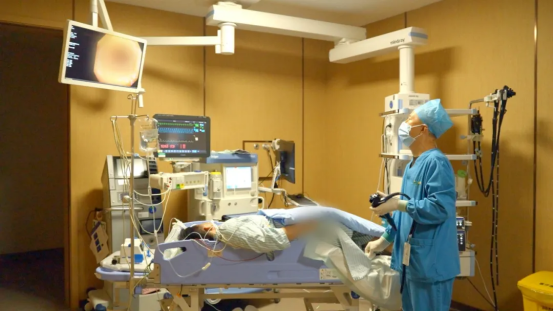
Dr. Zuping Li at work
Who Needs Colorectal Cancer Screening?
Who is at high risk for colorectal cancer? The National Health Commission's "Colorectal Cancer Screening and Early Diagnosis/Treatment Protocol (2024 Edition)" provides a self-assessment tool . It calculates a score for sporadic colorectal cancer risk based on age, sex, family history of colorectal cancer in first-degree relatives, smoking, and Body Mass Index (BMI), using the following principles:
1. Age: ≤49 years (0 points), 50-59 years (1 point), ≥60 years (2 points).
2. Sex: Female (0 points), Male (1 point).
3. Smoking History: No (0 points), Yes (1 point).
4. BMI: <23 kg/m² (0 points), ≥23 kg/m² (1 point).
5. First-degree relative (parent, child, sibling) diagnosed with colorectal cancer: No (0 points), Yes (1 point; Note: If one first-degree relative was diagnosed with colorectal cancer before age 60, OR if two or more first-degree relatives have been diagnosed, the score is 4 points).
Individuals with a cumulative score of ≥4 points from the above items are classified as the high-risk population .
Screening Age
For individuals at high risk for sporadic colorectal cancer with no personal history of the disease, screening is recommended between the ages of 40 and 74. If there is one first-degree relative diagnosed with colorectal cancer before age 60, or two or more first-degree relatives diagnosed, it is recommended to begin screening 10 years earlier than the age at which the youngest affected relative was diagnosed. No upper age limit for screening initiation is set in these circumstances .
Reference: Colorectal Cancer Screening and Early Diagnosis/Treatment Protocol (2024 Edition) .





 Customer satisfaction